
The Wisdom We Abandoned: How America Dismantled the Founders’ Restraints on War Power and Why It Now Threatens the Republic and the World
~Written by Wade John Taylor
If your source for information is legacy media or network news, you have a full understanding of governmental propaganda but are likely keenly aware that you have been lied to. Certain things around you just don’t add up, and the lies don’t carry much weight anymore. Our reality is much worse than we can contemplate. On the military front, we are nearly out of ammunition for many of our key weapon systems, from standoff precision missiles and air defense interceptors to 155mm artillery shells. Years of burning through stockpiles meant for war and leaving behind stockpiles of equipment and supplies when we leave an area of operations was bad enough, yet we have a diminishing capacity to produce more of what little we have left. We are in a position where we can no longer project the power we once could, and the minds that push the war machine around are lost in some sort of blood lust or bureaucratic ignorance. In short, we are no longer a global superpower and cannot secure passage of much needed oil, fertilizer, aluminum, helium, and other key ingredients needed for our industry and economy. We produce a great deal of petroleum products, but they are by and large the wrong kind. We need heavy sour crude to power our diesel, jet fuel, and distillates that keep our supply lines and industry functioning. By attacking Iran, we have given ourselves and the entire West a mortal wound that, if left unchecked, will lead to our demise.
Given the strategic defeat and humiliation we are facing in the Middle East, I looked towards the wisdom of our ancestors who forged this nation for some modern-day guidance. Regaining the checks and balances that were meant to be upon our military is a good place to start if we intend to stop the hemorrhaging of what is left of our military power. The American Founders did not limit executive war power as an abstract exercise in political theory that they had come up with while discussing the merits of inalienable rights. They limited power because their own experiences with their history had taught them what happens when one person controls the sword. They had firsthand knowledge of the tyranny of kings, standing armies, and concentrated power and authority. The tyrants of their day had repeatedly produced wars that ordinary people paid for in blood, liberty, and treasure. In both our first government under the Articles of Confederation and Perpetual Union and in our Constitution of 1787, the Founders made the decision for war difficult, collective, and accountable to the people’s representatives.
In this report, I briefly explain here that the original noble design has gradually been abandoned. In its place is a corrupt system in which a single elected official can initiate major hostilities even when Congress is available to convene and take up the matter. We have given that same President power where he can unilaterally depose foreign leaders by force and has the capacity to commit the nation’s professional military along with our critical resources without the consent or even the deliberate legislative judgment that our Constitution requires. This report traces the original design, the stages of its erosion, and the consequences now visible in both constitutional practice and material reality of our lives today.
I. The Founding Understanding of War
In an age where some people find it difficult to define what a woman is, it is fair to discuss what our nation’s earliest ancestors had to say about how they felt about war and what it is. At the founding, “war” meant a national decision to place the country in a state of hostilities against another sovereign. In short, if our representative leader wanted to punch someone in the nose, the President had to ask us first through our representatives. That sole decision to decide to throw the punch belonged to the legislature both in our first and current government. The grave consequences of conflict (bloodshed, public expense, expanded government power, and danger to liberty) followed the nation whether Congress used the formal words of declaration or not. Avoiding a declaration did not avoid the costs; it only weakened the accountability that the Constitution was designed to impose. It did not begin yesterday, but the tyranny we now exist in began early in our nation’s existence and has gradually increased over time.
The understanding of war and its price that our ancestors possessed was not something they read or guessed at; it came from experience. The Founders had lived under a heavily bureaucratic British system with a king at its head. Heavy taxes from multiple parties and the constant meddling of the King’s appointed Governors and henchmen allowed him power and dominion over the people. The monarch could unilaterally declare war, maintain standing armies, and use military force as an instrument of policy and coercion. The Declaration of Independence strongly condemned the king for keeping standing armies in peacetime without legislative consent and for making the military independent of, and superior to, civil authority. The English had a history (civil war, commonwealth, and restoration) while fighting for their own rights that reinforced the same lesson. Both the English and the American colonists understood that any permanent forces under executive control reliably and regularly threaten the liberty of a people.
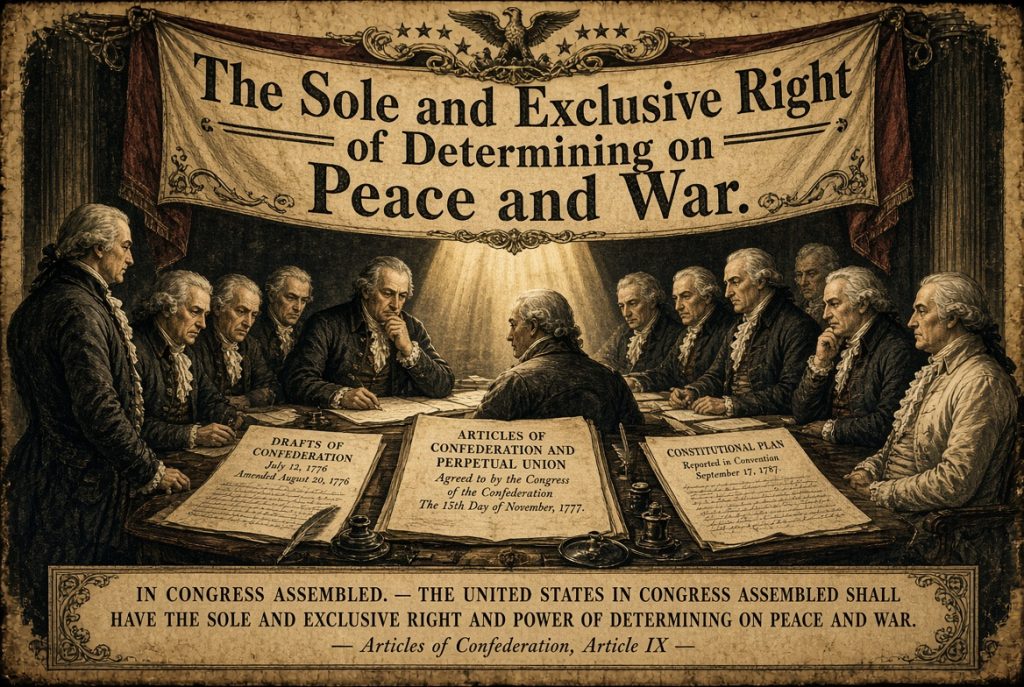
During our first government organized under the Articles of Confederation of Perpetual Union, all national war authorities rested in the unicameral Confederation Congress. It was purposefully put upon the representatives of the people that ultimately would bear the cost. Article IX gave the United States in Congress assembled “the sole and exclusive right and power of determining on peace and war,” except in limited cases of imminent state self-defense. Congress alone controlled treaties, letters of marque, captures, the appointment of officers, and the direction of land and naval forces. There were substantial barriers to conflict put in place on purpose, and raising substantial forces required the assent of at least nine states. History demonstrated that militaries placed under the complete control of an executive led to the oppression of the people. There was no separate national executive with independent military authority. General Washington and the military answered to the authority of Congress. This pure legislative model reflected deep distrust of concentrated executive power after the experience with the British Crown or any central authority. It proved cumbersome in practice, which is one reason many at the Constitutional Convention sought a more energetic executive for execution while retaining legislative primacy over the decision to initiate.
When we examine the Founders’ definition of war, we find that it was both practical and moral. War was too serious, too costly, and too dangerous for liberty to be left to the judgment of one person. Our ancestors experienced that firsthand under the monarchy backed up by a corrupt parliament. They understood intimately that actions and consequences (intended and unintended) of the use of force against another nation or people must be deliberated, discussed, and reasoned out by true representatives of the people well before any troops started assembling or artillery started firing. An elite class far away from war has no business causing people to kill and be killed over matters that the common man cares little about.
II. Drafting the Constitution and Deliberately Denying the Executive Power to Initiate War.
At the Constitutional Convention, the question of war powers was debated fervently because the delegates understood the stakes. Many of the delegates wanted to retain the government under the Articles of Confederation, but when they realized the convention was moving to replace what they had with a new constitution, they became gravely concerned about concentration of power, especially over war powers. When we examine their early discussions and deliberations, we see that they treated war and peace as legislative in nature. On the first full day of the Convention, they took up the discussion about the national executive. Charles Pinckney, a delegate from South Carolina, warned that giving a vigorous executive the old Confederation powers over “peace and war” would result in creating an elected monarch. John Rutledge concurred with his colleague from South Carolina and reinforced the position by stating that the chief executive would be best suited to focus on public affairs and the congress manages war and peace. James Wilson from Pennsylvania agreed that those powers should be reserved and that a chief executive should be strictly limited. From the record, “Mr. Wilson preferred a single magistrate, as giving most energy, dispatch and responsibility to the office. He did not consider the Prerogatives of the British Monarch as a proper guide in defining the Executive powers. Some of these prerogatives were of a Legislative nature; among others, that of war and peace &c. The only powers he conceived strictly Executive were those of executing the laws, and appointing officers, not appertaining to and appointed by the Legislature.”
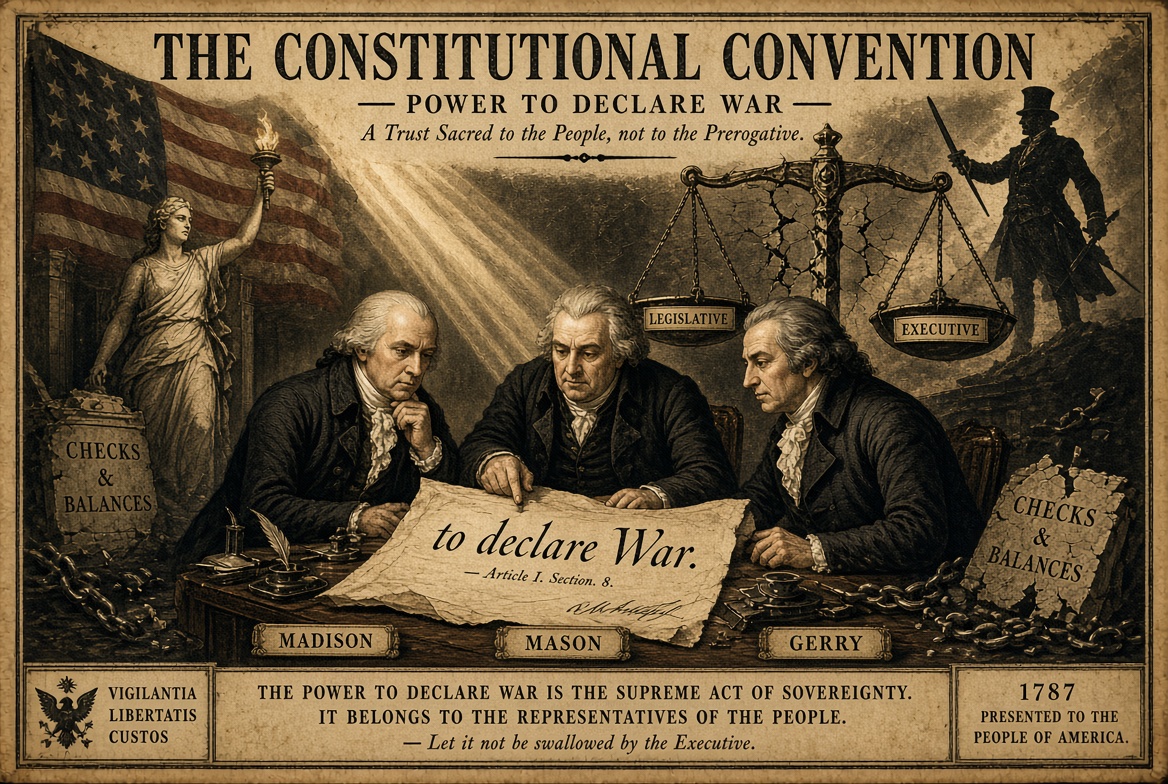
On 17 August 1787 the debate still raged, and delegates sought to put clear boundaries on the executive. The Committee of Detail draft still read “to make war.” James Madison and Elbridge Gerry moved to strike “make” and insert “declare,” expressly “leaving to the Executive the power to repel sudden attacks.” Gerry’s reaction to any suggestion of sole executive war-making remains the clearest statement of republican principle: he “never expected to hear in a republic a motion to empower the Executive alone to declare war.” Roger Sherman insisted the executive should be able to repel but not embark on the path to war. George Mason opposed giving the power of war to the Executive because it was not safely trusted with it; he preferred to “clog rather than facilitate war.” Pierce Butler’s proposal to vest the power in the President failed, further demonstrating that there was not support by the framers of the Constitution to give that power to a lone individual. The change from “make” to “declare” was adopted, and the record of the debate speaks to what they meant. The Convention rejected vesting the initiation of war in a single person. (Madison’s Notes of Debates in the Federal Convention of 1787, August 17.)
The Anti-federalists warned that this did not go far enough, but in Hamilton’s Federalist No. 69 he made the distinction explicit for the ratifying public. The President as commander-in-chief would be “nominally the same with that of the king of Great Britain, but in substance much inferior to it.” The British king’s authority extended to “the DECLARING of war and to the RAISING and REGULATING of fleets and armies,” all of which, under the Constitution, “would appertain to the legislature.” The American executive received the sword only after the legislature had authorized its use. The design was deliberate: energy in the executive for execution, deliberation and accountability in the legislature for the decision to begin.
III. Ratification Debates and the Anti-Federalist Warning on Standing Armies
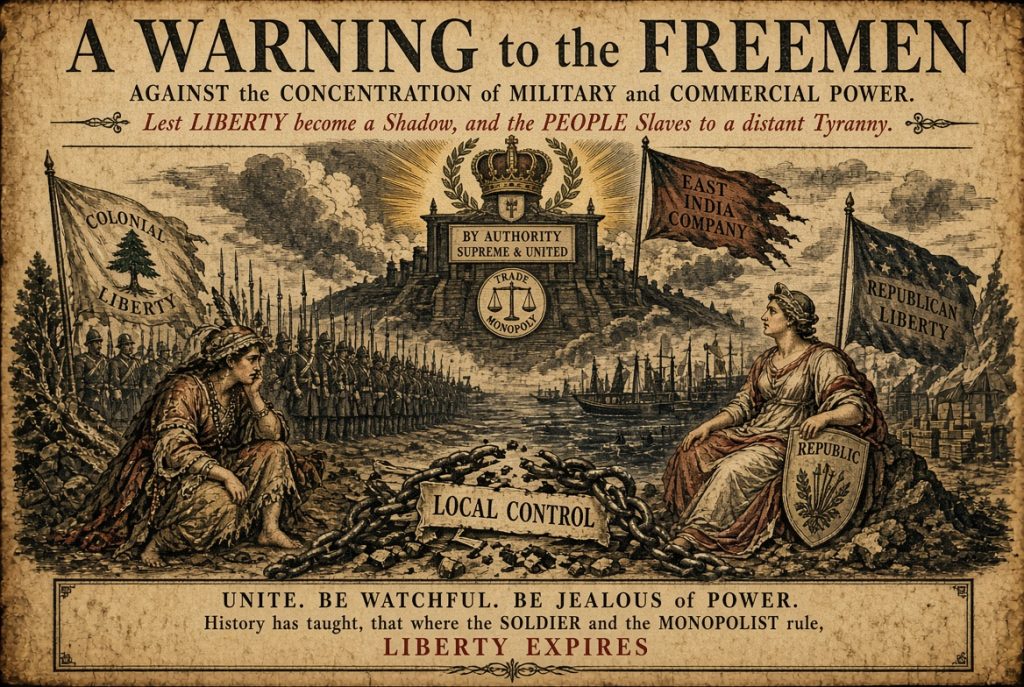
During ratification, Anti-Federalists focused less on the “declare war” clause itself and more on the broader military package. They had experienced their own version of the military-industrial complex via organizations like the East India Company. That company was not merely a trading firm, but a state sponsored organism of oppression. It was a chartered monopoly that raised its own armies, fought wars, collected revenues, administered territory, and operated as a quasi-sovereign power under the protection of the British state. By the mid-eighteenth century it fielded forces larger than those of many European nations and used military power to enforce commercial privilege. American colonists saw the results firsthand, and it was still on the minds of the delegates. For context, the Tea Act of 1773 was designed to rescue the Company’s finances by granting it special access to the American market; the Boston Tea Party was a direct rejection of that fusion of private commercial interest, parliamentary favoritism, and the threat of force.
Anti-Federalists carried that memory into the ratification debates and were weary of state sponsored militaries in every form. They repeatedly warned that a distant national government with unlimited taxing power and the authority to maintain a standing army in peacetime could recreate the same pattern: privileged commercial and financial interests allied with military force, insulated from local control, and able to pursue policies ordinary citizens neither chose nor could easily restrain. They were clear that their opposition to a permanent army, to expansive federal revenue powers, and to the concentration of the “purse and the sword” in the same hands was not some abstract theory but something they had experienced firsthand. It was the hard-earned conclusion drawn from watching a commercial monopoly backed by state military power dominate distant peoples and, at times, threaten the liberties of the colonists themselves. Ultimately, this paved the way for the king to deploy his armies against his own people to enforce taxes and subjugate the people.
In retrospect, the East India Company stood as a living example of what happens when commercial ambition, military capacity, and distant political authority are allowed to merge. The Anti-Federalists believed the proposed Constitution, if left unchecked, risked creating the American conditions for a similar merger.
They criticized the national government’s power to raise and support armies, the combination of the sword and the purse in the same national legislature, and the danger that a permanent force would become an instrument of those holding executive power. Brutus argued that standing armies had always proved the destruction of liberty in monarchies and despotic systems and were “abhorrent to the spirit of a free republic.” Federal Farmer contended that the two-year appropriations limit would prove illusory once an army existed; Congress would continue to fund it.
Federalists countered the Anti-Federalists by hanging their argument on the position that an elected Congress was safer than a hereditary king and that separating the decision to go to war from day-to-day command preserved liberty better than either pure legislative control under the Articles or pure executive control under monarchy. The underlying principle (that war initiation must not rest with one person) was not seriously contested, and the people of that age would not vote to give the authority of the legislature (even temporarily) to the executive. The Anti-Federalist concern about permanent forces enabling concentrated power was left as a live warning, and history has shown it was well-founded.
IV. How the Quasi-War Crisis gave Limited Authorization and was the First Step on the Slippery Slope.
We turn to the Quasi-War with France (1798–1800) as the first major practical test under the new Constitution. The French had been seizing American ships in what would be known historically as the XYZ Affair. There was no formal declaration of war, yet military action was taken. The public demanded action, yet Congress decided that a limited approach might be best. The historical road to misery is paved with good intentions.
The XYZ Affair began in 1797 when President John Adams sent a three-man commission (Charles Cotesworth Pinckney, John Marshall, and Elbridge Gerry) to Paris to negotiate an end to French attacks on American commerce. Their mission was to settle differences that sprang from the Jay Treaty with Britain and led to deteriorating relations with France. French Foreign Minister Talleyrand had refused to receive the envoys officially. Instead, he sent three of his agents to meet them privately and demanded a large loan to France, a substantial bribe for Talleyrand personally, and an apology for remarks Adams had made about French policy. The American commissioners rejected the demands. When Adams later transmitted the dispatches to Congress, he replaced the names of the three French agents with the letters X, Y, and Z to protect their identities in the published documents. The public revelation of the attempted extortion produced widespread outrage in the United States, the slogan “Millions for defense, but not one cent for tribute,” and the political climate that led Congress to authorize limited naval action.
Congress responded to the public pressure with a series of specific statutes that carefully defined the scope of authorized force. These included:
- The Act of 28 May 1798, authorizing the President to instruct commanders of public armed vessels to seize armed French vessels that committed depredations on American commerce.
- The Act of 13 June 1798, suspending commercial intercourse with France.
- The Act of 25 June 1798, authorizing merchant vessels to defend themselves and to capture armed French vessels that attacked them.
- The Act of 7 July 1798, formally abrogating the treaties with France.
- The Act of 9 July 1798, further authorizing the President to instruct naval commanders to subdue, seize, and take any armed French vessel found within the jurisdictional limits of the United States or elsewhere on the high seas.
In addition to expanding Presidential powers, Congress also created the Department of the Navy, expanded the naval force, and regulated the disposition of prizes. While President Adams operated honorably and strictly under these statutes, a precedent was set that later dishonorable Presidents would expand upon. He did not claim an independent constitutional power to initiate or expand hostilities beyond what Congress had written; he simply executed and acted on what was authorized.
The Supreme Court reinforced the slippery slope when they later treated the conflict as an “imperfect” or limited war authorized by Congress. In Bas v. Tingy, 4 U.S. (4 Dall.) 37 (1800), the justices recognized that Congress could authorize limited hostilities short of full declared war. Justice Washington stated that hostilities might be “of a limited nature” and still constitute war in the legal sense; Justice Chase described the situation as a “qualified” state of hostility. The Court accepted that France was an “enemy” for purposes of the prize statutes even without a formal declaration.
In Talbot v. Seeman, 5 U.S. (1 Cranch) 1 (1801), Chief Justice Marshall wrote the controlling principle:
“The whole powers of war being, by the constitution of the United States, vested in Congress, the acts of that body can alone be resorted to as our guides in this enquiry.”
As long as Congress alone defined the enemy, the objects of hostilities, and the limits of authorized force, the action or conflict was valid. The President’s only role was to execute within those statutory boundaries.
In Little v. Barreme, 6 U.S. (2 Cranch) 170 (1804), the Court went further. A presidential naval order had directed commanders to seize vessels sailing to or from French ports. The authorizing statute, however, permitted seizure only of vessels sailing to French ports. Chief Justice Marshall held that the presidential order exceeding the statute was unlawful. Military orders could not override the limits set by Congress; a commander following an illegal order remained liable. Every officer had a duty to abide by the restrictions of Congress, not the explicit orders of the President. The decision underscored that even in the middle of limited hostilities, the President’s authority as commander-in-chief had boundaries established by the precise terms of congressional authorization. The President is the Commander in Chief with operational and strategic control but not the ultimate authority. Even in a fully declared war, Congress holds authority over the funding, rules for the regulation of the forces, and retains ultimate authority to conclude or limit the war.
This body of practice and precedent established a workable model for limited, congressionally authorized force short of a full declaration of war. It confirmed that “war” in the constitutional sense included imperfect or partial hostilities, and that Congress (not the President) held the power to authorize them.
At the same time, it opened the door. Once limited authorization without a formal declaration was accepted as legitimate, the boundary between tightly defined congressional force and broader executive-led campaigns became contestable. Subsequent practice gradually stretched the Quasi-War precedent. Presidents increasingly treated residual commander-in-chief authority or broadly worded authorizations as ongoing licenses. Congress, for its part, rarely forced clean, repeated votes on the continuation or expansion of hostilities once they had begun and certainly never bothered to repeal legislation that was no longer needed or relevant. What began as a carefully bounded statutory response to French depredations became the first practical step on a slope the Founders had tried to make steep: the movement from legislative control over the decision to make war toward executive initiative sustained by ambiguous or aging authorizations.
V. Examining Madison’s April 1798 Letter to show the Clearest Statement of the Structural Premise
Turning to our Founding Fathers for how they handled the affair, we find that Adams and Jefferson were aware of the constraints and had a reverence for them. Writing to Jefferson on 2 April 1798 amid Adams administration pressure for stronger measures, Madison stated the premise with clinical clarity:
“The constitution supposes, what the History of all Govts demonstrates, that the Ex. is the branch of power most interested in war, & most prone to it. It has accordingly with studied care, vested the question of war in the Legisl.” (James Madison to Thomas Jefferson, 2 April 1798, in “The Papers of James Madison”.)
He then went further to leave no ambiguity. Executive actions (messages, indirect licensing, creation of foreign missions that generate faits accomplis) can place Congress in a position where the only remaining choices are war or humiliation. If the President’s opinion rather than facts and proofs sways the legislature, or if executive steps create irreversible momentum, the people are “cheated out of the best ingredients in their Govt., the safeguards of peace which is the greatest of their blessings.” Madison saw the danger not only in formal declaration by the executive but in executive creation of conditions that functionally compel legislative endorsement. That warning has proved prophetic when you hold it up to executive actions nowadays. Later patterns of incremental commitment and the creation of irreversible facts on the ground follow exactly the logic he identified in 1798.
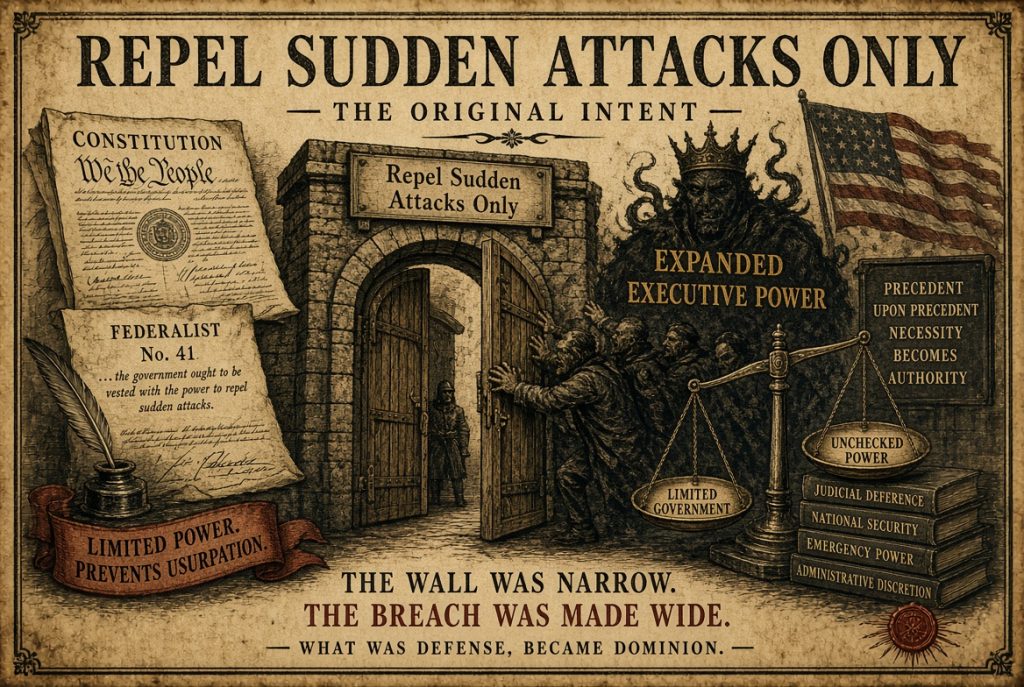
VI. The Morphing of “Repel Sudden Attacks” and the Realization of Standing-Army Warnings
It is clear from the historic record that the Founding Fathers’ original intent was narrow: defensive response to sudden attack when Congress cannot convene in time. Absolutely everything else (initiation, escalation, sustained campaign) required legislative action. Back then it took time for representatives to gather when the primary mode of transportation was by horse or carriage. It takes far less time today for members to gather, particularly when there is a national emergency.
The practice of subsequent administrations evolved over time through limited authorizations (Quasi-War, Barbary Wars), broader claims of defensive necessity, executive interpretations of residual authority, and finally open-ended Authorizations for Use of Military Force. The 2001 AUMF (Pub. L. 107-40, 115 Stat. 224), enacted on September 18, 2001, authorized the President “to use all necessary and appropriate force against those nations, organizations, or persons he determines planned, authorized, committed, or aided the terrorist attacks that occurred on September 11, 2001, or harbored such organizations or persons.” The statute itself contains no reference to “associated forces.” That concept was developed by successive executive branches and accepted, with little pushback, by Congress and the courts in detention contexts. The legislators of today seem wholly derelict in their duties and rarely show concern for unilateral Presidential use of force even when leaders of foreign nations like Venezuela are captured by our military.
Legal challenges to the expanding scope of the 2001 AUMF have largely failed to produce definitive limits. In “Hamdi v. Rumsfeld”, 542 U.S. 507 (2004), a plurality of the Supreme Court held that the AUMF authorized the detention of enemy combatants as a “fundamental incident” of the use of military force against al-Qaeda and the Taliban. Later challenges, such as “Hedges v. Obama” (challenging the detention provisions of the National Defense Authorization Act as relying on an overbroad reading of the AUMF), “Smith v. Obama” (a service member’s challenge to operations against ISIS under the 2001 AUMF), and “Doe v. Mattis” (habeas challenge involving an alleged ISIS detainee), were typically resolved on standing, political-question, or mootness grounds before courts reached the merits of the “associated forces” theory. Administrations of both parties continued to interpret the AUMF as covering groups that did not exist in 2001 and operations far removed geographically from the original conflict. Congress largely ratified the expansion through continued funding rather than new, limited authorizations.
Meanwhile, the Anti-Federalist warning on standing armies was realized. Post-1945 reality produced the most capable permanent professional military on earth; continuously funded, globally projected, and available for immediate use. The existence of that force removed the practical need for Congress to raise new armies for each contingency. Presidents gained a ready instrument and expanded their use of it with each subsequent administration. The structural check the Framers relied upon (no force until the legislature authorized and funded it) was inverted: the force already exists; the political question becomes whether Congress will cut it off. That is a far weaker restraint, and it is the one we now live under.
VII. The History, Intent, and Practical Failure of the War Powers Resolution
Another crack in the boundaries formed in 1973 towards the end of the Vietnam Conflict. The War Powers Resolution (Pub. L. 93-148, 87 Stat. 555) was enacted on November 7, 1973, over the veto of President Richard Nixon. Nixon’s veto message of October 24, 1973, called the measure both dangerous and unconstitutional, arguing that it would take away by statute authorities the President properly exercised under the Constitution and that its automatic 60-day cutoff would impair the ability to respond to crises. Congress overrode the veto as it was clear by then that the President and previous administrations had already taken on too much authority. Again, the road to miserable places is paved by those with good intentions.
The Resolution’s stated purpose was “to fulfill the intent of the framers of the Constitution of the United States and ensure that the collective judgment of both the Congress and the President will apply to the introduction of United States Armed Forces into hostilities.” Section 2(c) declared that the President’s constitutional powers as Commander-in-Chief to introduce forces into hostilities are exercised only pursuant to (1) a declaration of war, (2) specific statutory authorization, or (3) a national emergency created by attack upon the United States, its territories or possessions, or its armed forces. It required reporting within 48 hours and imposed a 60-day termination clock (extendable by 30 days for withdrawal) unless Congress declared war, specifically authorized continued use, or was itself unable to meet because of an attack. It also provided for congressional direction of removal by concurrent resolution.
In practice, the Resolution has not restored the Framers’ design. Presidents of both parties have submitted reports while disputing the Resolution’s constitutionality or its applicability to particular operations. The 60-day clock has rarely been enforced. The concurrent-resolution termination mechanism was undermined by the Supreme Court’s decision in *INS v. Chadha*, 462 U.S. 919 (1983), which invalidated legislative vetoes that did not comply with bicameralism and presentment. Broad AUMFs, especially the 2001 authorization, have been treated as ongoing “specific statutory authorization,” rendering the clock largely irrelevant for those conflicts. The Resolution further provided a procedural framework that in many cases normalized limited or ambiguous congressional involvement rather than forcing the collective decision the Framers required. Executives continue to push the boundaries further, with each administration using prior administrative actions as legal precedent.
Congress enabled the accretion by declining to exercise its core power: avoiding formal declarations since 1942, passing temporally open AUMFs that executives treat as continuing licenses, funding operations while declining to force clean votes on continuation or expansion, and allowing the Resolution’s enforcement mechanisms to atrophy. This was not neutral inaction because by declining to reclaim the decision, Congress functionally transferred the initiative. The legislature retained formal power while surrendering practical responsibility by simply doing nothing about it over time.
VIII. Contemporary Manifestation: 2026 Operations as the Endpoint of the Drift
By 2026 the pattern had become operational fact. On 3 January 2026, U.S. forces conducted a military operation that captured Venezuelan President Nicolás Maduro and his wife and removed them from the country. The action was executed without a congressional declaration of war or specific prior statutory authorization under the War Powers framework. International legal observers characterized it as a violation of the UN Charter’s prohibition on the use of force against the territorial integrity or political independence of another state. Congress considered but did not force binding termination resolutions. This is by far the clearest modern instance of an American president unilaterally deposing a foreign head of government by military means; the precise concentration of power the Framers denied the executive.
The same administration has advanced claims that the United States should acquire or take control of Greenland, an autonomous territory of NATO ally Denmark. Rhetoric included statements that the United States would obtain it “one way or the other” and, at points, refusal to rule out force. While later statements walked back explicit military plans, the open coercive posture toward an ally’s territory illustrates the same executive initiative unconstrained by the original requirement of legislative decision for major uses of national power. Had Congress not surrendered its responsibility, such statements would have remained purely toothless.
The unilateral acts of aggression have not stopped there. A sustained military campaign involving U.S. strikes on Iranian targets and Iranian retaliatory attacks on U.S. bases and facilities across the Gulf region produced documented high costs. Reporting indicates heavy expenditure of precision munitions (Patriot, THAAD, and other long-range stocks significantly drawn down), damage to or destruction of multiple radar and surveillance systems, and strikes on U.S. and partner bases in the region. Iran has asserted control over, and at times has closed, the Strait of Hormuz (the chokepoint through which a large share of global oil and gas has historically passed), disrupting commercial traffic and elevating energy prices. While both sides claimed measures of control, the strategic waterway was no longer the reliably open international passage it had been under prior U.S. naval predominance. Forward-deployed U.S. forces that once operated with relative sanctuary absorbed direct attacks. These are just some of the concrete costs of a major undeclared conflict initiated and expanded under residual executive authority.
IX. The Bronze Age Parallel and Modern Material Fragility
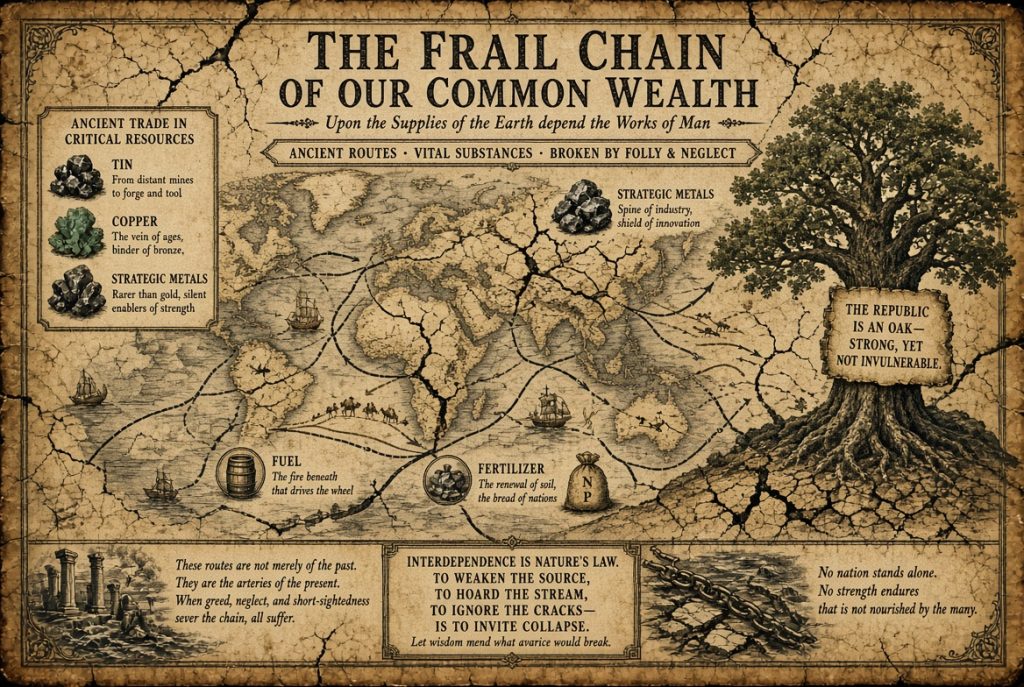
The consequences of reckless action during unstable times can be seen across the ages, and there are interesting parallels that we can draw from. While some point to the Roman collapse of the Republic into a Dictatorship with a Senate in tow as a good model to draw from, I have found some interesting parallels to an earlier time. The Late Bronze Age collapse of the late 13th to early 12th century BC was a systems failure across an interconnected network of civilizations. Those societies depended on long-distance trade for tin; the scarce alloying agent required to produce bronze, the strategic metal of the age. Copper was more widely available; tin sources were distant and limited. When trade routes fractured under multiple stressors, the supply of the critical material failed. The interdependent political and economic systems that had grown complex and specialized over generations could not adapt quickly. Administrative capacity, literacy, and urban complexity declined across a wide region as one civilization after another, previously organized peaceful people turned into hordes of desperate, hungry refugees.
Modern industrial civilization exhibits comparable dependencies. Oil, diesel, jet fuel, natural-gas-derived fertilizers (ammonia, urea), helium, aluminum, and related commodities function as the strategic materials of our generation. Large shares of the global seaborne trade in these materials transit or originate near the Strait of Hormuz and other chokepoints. Helium, essential for semiconductor fabrication and medical imaging, has limited sources and no easy strategic reserve. China has prohibited export of Helium to prevent a shortage in its own factories, further reducing the available supply. Food is also affected as fertilizers underpin global food production and are amplified by our current global drought conditions. Diesel and jet fuel enable logistics and power projection. How will the world move things when its trains, trucks, and ships have no fuel to move the essentials of modern life? Aluminum, another critical global commodity, is also in short supply. It affects construction, transport, and manufacturing, and the largest Aluminum plant in the world is offline due to the conflict. These are only a few critical components of our modern society affected by our government’s decision to abdicate their responsibilities for convenience or profit. Disruption of these flows does not merely raise prices; it stresses the physical basis of our industrial and agricultural systems.
When executive-led conflict closes or contests a critical chokepoint, draws down precision munitions faster than industrial replenishment, and damages the surveillance and base infrastructure required for sustained operations, the parallel becomes operational. Complexity and interdependence that once conferred advantage become sources of cascading vulnerability. The Founders’ structural restraint on war initiation was, among other things, a safeguard against precisely this form of self-inflicted systemic risk. One person should never have the ability to jeopardize the liberty and livelihood of the people.
X. Generational Amnesia and the Return of What the Republic Was Designed to Leave Behind
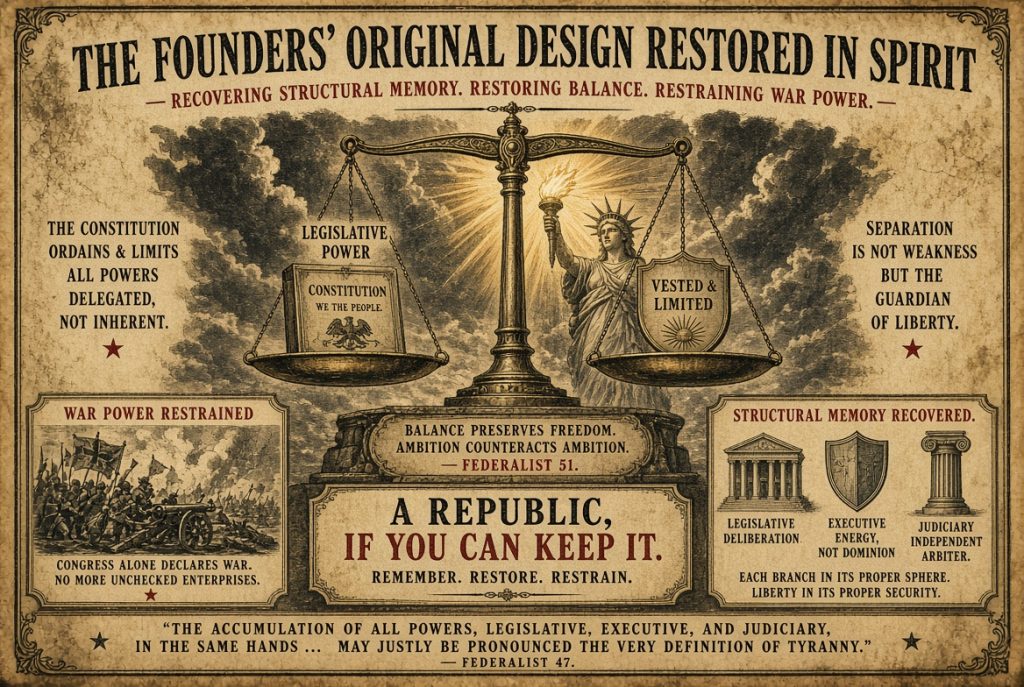
The Founders encoded structural memory of monarchical overreach into the Constitution because they had experienced it for themselves. Later generations treated those restraints as historical curiosities rather than hard-won engineering against known human and institutional failure modes. Permanent military capacity, global logistics, and critical-material dependence were allowed to accumulate under an executive that retained the initiative. While in theory Congress retained the formal power to declare war and control the purse but in practice, they repeatedly declined to force the political costs of ownership. The result is a system augmented for rapid executive action and poorly equipped for the deliberate, accountable decision the Constitution required.
We are now all collectively gaining the knowledge that our ancestors had. The costs are no longer theoretical: munitions inventories drawn down, regional bases and sensors degraded, a strategic waterway contested, commodity markets shocked, and the perception of American power and reliability altered. Further escalation or simultaneous stresses on multiple chokepoints and material streams would test the resilience of an order that has outgrown the political and constitutional constraints designed to keep it from overreaching.
The Bronze Age societies did not collapse because they lacked courage or technical skill. They collapsed because complex, interdependent systems dependent on scarce strategic materials proved brittle when political and military disruptions severed the networks that sustained them. Our Founding Fathers were avid students of history and did their best to put constraints into our system. Yet without being avid students of history, our legislature has failed to take its responsibility seriously. The American constitutional design was an attempt to reduce the frequency and scale of such disruptions by making the decision for war difficult and collective, and we ought to remember that. The progressive abandonment of that design has returned the republic to the very pattern of concentrated executive initiative the Founders had experienced and rejected; the elected monarch they warned against, now backed by the most powerful standing military in history and operating inside a global system whose critical material flows are vulnerable to the conflicts that same executive can initiate. What good are our ships, planes, and troops if we have no food, fuel, or ammunition?
Primary sources and the historical record remain the controlling evidence for how our nation should be operating. Practice has diverged, and responsibility has been neglected by those we have voted for on all sides of the political spectrum for quite some time. The divergence is now measurable in both constitutional form and material consequences like a tsunami pulling out to shore before the wave comes in. Whether the parallel from the past remains cautionary or becomes prophetic depends on whether the structural memory the Founders left us (encoded in our founding documents or accessible in their memoirs) can still be recovered before we are left materially, strategically, or economically exhausted.
The wisdom was never theoretical. It was practical, hard-earned, and designed to protect a free people from the very concentration of power that now sits at the center of American statecraft. Ignoring it has already produced costs that will be felt for generations. Continuing to ignore it risks consequences the Founders understood all too well.