

Friends and fellow travelers in liberty,
Step through the low doorway on Green Dragon Lane in Boston’s North End on an evening in 1773 and the first thing that strikes you is the smell. Wood smoke from the central fireplaces hangs thick in the air, mixing with the sharp tang of spilled ale, the sweet bite of tobacco from clay pipes, and the heavier scent of damp wool and unwashed labor from the men who have come in from the waterfront. The room is dimly lit by candles and lanterns, the low ceiling pressing down, the floorboards worn smooth by decades of boots. In one corner, a group of merchants in good coats speak in low voices over tankards. Near the bar, dockworkers and sailors in heavier cloth lean in, their faces half-hidden in the smoke. Up the narrow stairs, behind a closed door, the members of St. Andrew’s Masonic Lodge conduct their formal business. Down here in the basement tavern, another kind of business is underway.
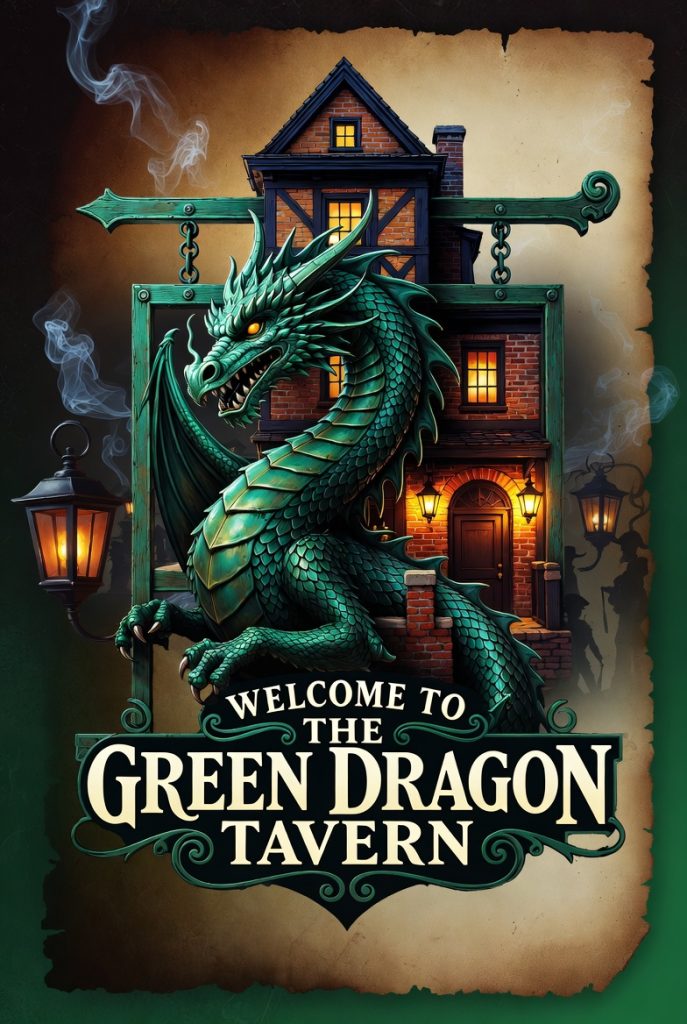
The building itself was substantial for its time, a brick structure with two stories facing the street and three in the rear, sitting on roughly three-quarters of an acre that included a garden behind. A large copper dragon, mounted on an iron crane, swung above the entrance. Boston’s salty air and sea climate had long since turned the metal a vivid green, and the owners had stopped trying to keep it polished. That oxidized dragon gave the place its name. The tavern had been operating on this spot since at least the early 1700s. The land itself went back further, acquired by William Stoughton before 1676 and later inherited by his niece. In 1743, a physician and pamphleteer named William Douglass bought the property and lived in it, calling it his mansion house. After his death, the tavern passed to his sister, who sold it in 1766 to St. Andrew’s Lodge of Freemasons.
That purchase changed everything and changed nothing at the same time. The Masons took the upper floors for their meetings under the leadership of Dr. Joseph Warren. The basement remained a public tavern, open to any man with coin for ale. This dual arrangement gave the place its peculiar strength. On the surface, it was a respectable establishment with a chartered fraternal order upstairs. Beneath that surface, in the half-light and smoke, the Sons of Liberty, the Boston Committee of Correspondence, and the North End Caucus of mechanics and neighborhood leaders met, argued, and planned. Samuel Adams held influence here. Paul Revere, a silversmith and Mason, was a regular. Benjamin Edes of the Boston Gazette moved through these rooms. So did merchants, artisans, dockworkers, and laborers. The Green Dragon worked because it was not a single class or a single secret society. It was a coalition that crossed lines of wealth and occupation, bound by the conviction that the liberties they claimed could not survive under the direction of a distant Parliament and an unaccountable Crown.
The British knew what was happening. They called the Green Dragon a nest of sedition. Yet they did not raid it or arrest its most prominent patrons in the years before open war. Part of the reason was practical. The tavern operated under the legal cover of a public house and a recognized Masonic lodge. Shutting it down or hauling away men like Joseph Warren or John Hancock on thin evidence would have required justification that could easily backfire in a city already restive. The British had limited troops in Boston before 1774, and they understood that overt repression of a place with such broad local support risked turning passive discontent into active resistance. The men who met there understood this too. They kept their most dangerous conversations among trusted circles, used the legitimate Masonic meetings upstairs as cover, and conducted the rest in the ordinary noise of a busy tavern where one more heated discussion over ale drew little notice.
That arrangement was held until the street itself changed. In 1832, Green Dragon Lane was widened and renamed Union Street. The old brick building, by then more than a century old, was demolished to make way for new construction. A warehouse rose in its place. The original copper dragon sign disappeared, though stories persisted that it had been preserved by a Mason at the time. The physical headquarters of the Revolution was gone, erased by the ordinary progress of a growing city.
What remained was the example. The Green Dragon Tavern was never merely a place to drink. It was a place where men from different stations learned to trust one another, where strategy was debated until it became action, and where the cost of liberty was counted in plain language over ordinary tables. The riders carried the alarm. The printers carried the arguments. The men who gathered here turned both into organized will.
That is the tradition we intend to carry forward in this space.
Behind this paywall, we will do what they did. We will examine principles with care. We will discuss history with precision. We will consider practical steps, sources, and methods that require a measure of trust and commitment. Some conversations will be open to all paid subscribers. Some will be reserved for private, deeper dialogue. All of it will be conducted in the same spirit that once filled a low-ceilinged room on Union Street: clear-eyed, principled, and unwilling to surrender what was won at such great cost.
If you have chosen to step inside, welcome. The work continues.
We ride in their company.
Elizabeth Jane Taylor & Wade John Taylor Publisher & Editor THE PAMPHLET LLC